Shadow AI & Agent Discovery
Passive discovery of the sanctioned and unsanctioned AI agents, LLM models, MCP servers and tool integrations in use across your AI users. 162+ foundation models, 1,000+ agent and tool profiles. Records only the unique usage needed for governance — no raw payloads stored, and nothing installed on an endpoint.
Works with every shadow ai discovery
 AWS Bedrock
 Azure AI Foundry
 Google Vertex AI
 Cloudflare
 Palo Alto Networks
 Zscaler
 Kubernetes
 NextDNS
 LiteLLM
 Native Scanner
See Shadow AI Discovery in action
Watch Gödel discover unauthorized AWS Bedrock Agents, self-hosted models on Kubernetes, and unsanctioned model endpoints—reducing raw signals to clean, actionable governance states without storing sensitive prompts.
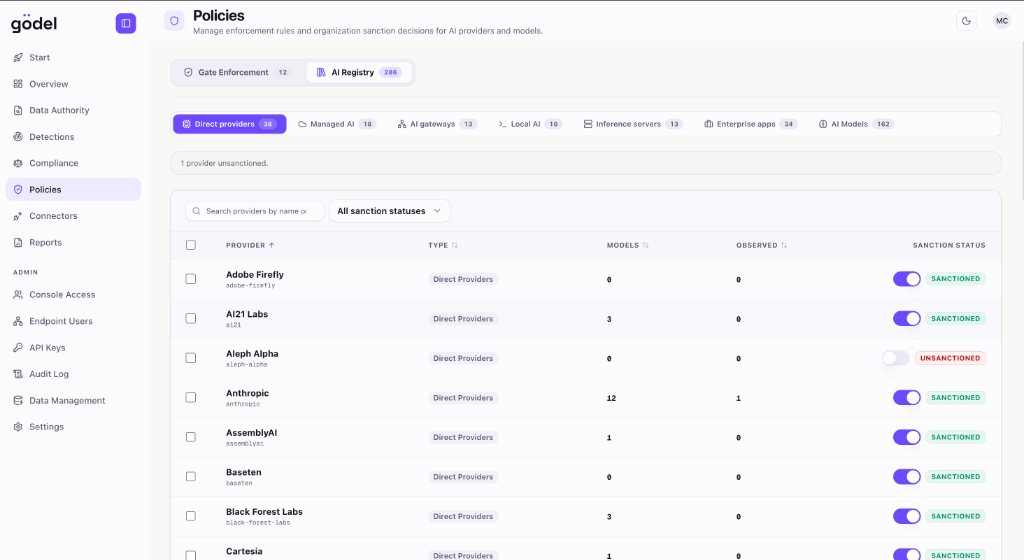
Three ways AI arrives uninvited.
Three governance states.
Real findings from the discovery path. Every observation is attributed to a user and a device, reduced to a unique provider–model pair, and placed in a sanction state for an operator to decide.
Unapproved AWS Bedrock Agents
UNDECIDEDAWS Bedrock Connector → bedrock:ListAgents
Engineers spin up unapproved AWS Bedrock Agents. Atlas discovers the new agents via scheduled API sync and places them in the Authorization Queue for review.
Self-Hosted Model on Kubernetes
UNDECIDEDK8s Discovery → Self-Hosted HuggingFace
An agentless K8s cluster scan detects a pod running an unknown local model. Operators review the findings and can sanction it for internal testing.
Shadow API Usage on Corporate Device
UNSANCTIONEDPalo Alto Networks → api.anthropic.com
Developers use personal API keys to query Claude directly. HTTPS logs flag the outbound traffic, which is marked Unsanctioned as it violates enterprise agreements.
Detected across the estate.
Nothing installed.
Detection runs across cloud APIs, gateways, network telemetry and local infrastructure — reading sources your estate already produces. No endpoint agent. Atlas extracts only operational context to govern usage; zero raw chat payloads or streams are stored.
Cloud AI Platforms
Direct API telemetry across managed cloud AI infrastructure
| Connector | Type |
|---|---|
| Cloud API |
| Cloud API |
| Cloud API |
AI Gateways & Proxies
Traffic inspection through corporate AI routers and reverse proxies
| Connector | Type |
|---|---|
| Gateway |
| Router |
 | Reverse Proxy |
Internet Access & Security
Egress monitoring across Secure Web Gateways and live DNS
| Connector | Type |
|---|---|
| SWG / NSS |
| Zero Trust |
| Live DNS |
| Firewall |
| CASB |
Infrastructure Discovery
VPC packet flow logs, cluster scanners and native host daemons
| Connector | Type |
|---|---|
AWS / Azure / GCP VPC Flow Logs | VPC Flow |
| K8s Daemon |
| Host Daemon |
Already running Zscaler or Palo Alto? Atlas reads what they already see — no rerouting, no second chokepoint.
The 4 core controls,
working on this outcome.
Discovery isn't an isolated scanner. Every phase feeds continuous posture into our policy and sanctions engine.
Ingestion
Connectors ingest raw source metadata from DNS queries, network flows, cloud APIs, and proxy logs across your infrastructure.
Normalization
Raw streams are buffered in-process and normalized into standard observations. Buffers are transient and emptied on restart to protect privacy.
Detection
Normalized observations are analyzed to identify the specific AI providers, foundation models, agent frameworks and MCP tool integrations in use.
Governance State
Observations are reduced to a unique (provider, model) finding and linked to the host device and user, ready for policy enforcement.
End-to-End Discovery Pipeline
A strict four-step reduction process: raw source metadata is buffered in-process, normalized into standard observations, mapped to 162+ foundation models, and attributed to the host user.
"Shadow AI" refers to the usage of unsanctioned, unvetted, or unknown Artificial Intelligence services, models, or agents by employees within an organization. Gödel Atlas — the discovery component of Gödel Gate — is designed to passively discover this AI usage across the entire enterprise technology stack.
Its philosophy is to record only the unique usage needed for governance—it does not store raw payloads or chat streams. Instead, it extracts the operational context (who, what device, which provider, which model) and reduces it to a clean governance state.
The discovery pipeline follows a strict four-step reduction process: Connectors ingest raw source metadata (e.g., DNS queries, network flows, cloud APIs, proxy logs). The raw streams are buffered in-process and normalized into standard observations. Normalized observations are analyzed to identify specific AI providers and foundation models. Finally, the observation is reduced into a unique finding, linked via foreign keys to the connector, the host device, and the endpoint user that supplied the operational context.
The Sanctions and Governance Model.
Once shadow AI or an unknown agent is discovered, Atlas — the discovery component of Gödel Gate — applies its global sanctions model to govern usage.
Provider Sanctions
Apply to a specific API, cloud platform, or local runtime.
Model Sanctions
Global across all providers. For example, sanctioning Llama-3 applies whether it is hosted on AWS, Azure, or locally.
State: Undecided
Newly discovered, unknown AI providers and models are placed in the Authorization Queue for review.
State: Unsanctioned
Generates a violation when usage is detected. Set on a provider it applies to that provider; set on a model it applies globally, across every provider hosting it.
Explore other use cases
Find every agent you didn’t know you had.
Agentless discovery, connected in minutes. Every model, agent and tool integration in your estate — inventoried, attributed, and queued for a decision.